
Why Patience Is a Trading Skill, Not a Personality Trait
Ask a new trader what they need to become successful and you’ll usually hear the same answers.
A better strategy.
A better indicator.
A better scanner.
A better mentor.
More capital.
More screen time.
More knowledge.
Rarely does someone answer:
Patience.
And yet, after working with traders for years, I have become convinced that patience may be one of the most valuable skills in the entire business.
Not because patience guarantees success.
But because impatience almost guarantees mistakes.
The market is full of people who know what to do.
The challenge is waiting long enough to actually do it.
The Hardest Part of Trading
Most people assume trading is difficult because markets are complicated.
Markets are complicated.
But that is not usually the hardest part.
The hardest part is waiting.
Waiting for the setup.
Waiting for confirmation.
Waiting for the proper entry.
Waiting for your plan.
Waiting while everyone else appears to be making money.
Waiting while social media celebrates trades you didn’t take.
Waiting while a stock starts moving without you.
Waiting when you desperately want to act.
This is where most traders fail.
Not because they lack knowledge.
Because they lack patience.
Action Feels Productive
Human beings are wired to take action.
When we face uncertainty, we want to do something.
When we face discomfort, we want to do something.
When we feel like we’re falling behind, we want to do something.
Trading exploits this tendency relentlessly.
Many traders sit down at their screens believing they need to trade.
Not because an opportunity exists.
Because they are there.
Imagine a fisherman standing at a lake.
The fish are not biting.
The conditions are poor.
The fisherman becomes frustrated and starts throwing his line randomly in every direction.
Has he improved his chances?
Of course not.
He has simply become active.
Many traders confuse activity with productivity.
The market knows the difference.
Why Missing a Trade Is Not a Problem
One of the biggest breakthroughs in a trader’s career occurs when they stop fearing missed opportunities.
This sounds simple.
It isn’t.
Many traders believe every missed trade is a loss.
It isn’t.
A missed trade is simply a missed trade.
Nothing more.
The market will open tomorrow.
The market will open next week.
The market will open next month.
Opportunities never stop appearing.
Yet many traders act as if every move is the last move they will ever see.
This scarcity mindset creates terrible decisions.
It creates chasing.
It creates FOMO.
It creates unnecessary losses.
Professional traders understand something important.
Missing a trade is frustrating.
Taking a bad trade is expensive.
There is a difference.
The Market Owes You Nothing
One of the most dangerous beliefs a trader can have is the idea that they deserve opportunity.
They’ve been watching all morning.
They’ve been waiting all day.
They’ve been studying all week.
Surely the market should provide something.
The market disagrees.
The market owes you nothing.
The market does not care how long you’ve waited.
The market does not care how hard you’ve worked.
The market does not care how badly you want a trade.
Your desire for opportunity does not create opportunity.
Only the setup creates opportunity.
Learning this lesson saves traders enormous amounts of money.
The Story of the Perfect Entry
One of the most common questions traders ask is:
“What was the best entry?”
Interestingly, the answer is often not the earliest entry.
Many traders assume the first opportunity is automatically the best opportunity.
That is rarely true.
Imagine a stock that gaps down significantly.
The opening bell rings.
Price begins moving higher.
Aggressive traders jump in immediately.
The stock moves a little higher.
Then it stalls.
Then it drifts sideways.
Then it pulls back.
Hours later the stock finally proves itself.
The trend becomes clearer.
Buyers become more aggressive.
The probability improves.
Only then does the real opportunity emerge.
Most traders were too busy chasing the first move to recognize the better one.
The market rewards patience.
Not speed.
Why Chasing Feels So Good
There is a reason traders chase.
It provides emotional relief.
The moment you enter, uncertainty decreases.
You no longer have to decide.
You no longer have to wait.
You no longer have to watch.
The emotional tension disappears.
The problem is that emotional relief is not a valid trading strategy.
Many traders enter simply because they are tired of waiting.
Not because the setup improved.
Not because the probability increased.
Because the waiting became uncomfortable.
That is not trading.
That is emotional management disguised as trading.
The Difference Between Aggressive and Professional
Many traders confuse aggression with skill.
They believe the fastest trader wins.
The earliest trader wins.
The boldest trader wins.
Sometimes that happens.
Long term, professionalism wins.
Professional traders understand something important.
The goal is not to enter first.
The goal is to enter correctly.
Those are very different objectives.
An aggressive trader wants action.
A professional trader wants probability.
One is seeking excitement.
The other is seeking edge.
Why the Best Entries Often Feel Boring
The perfect entry rarely looks dramatic.
It rarely creates excitement.
It rarely attracts attention.
More often, it feels obvious.
The stock has already proven itself.
The trend has already developed.
The probability has already improved.
The uncertainty has already decreased.
Ironically, many traders avoid these entries because they feel late.
Yet these are often the highest probability opportunities available.
The market frequently rewards confirmation more than anticipation.
Not always.
But often enough to matter.
Waiting Is Risk Management
Most traders think risk management begins after entry.
It doesn’t.
Risk management begins before entry.
Every trade you avoid reduces risk.
Every poor setup you skip improves performance.
Every unnecessary trade preserves capital.
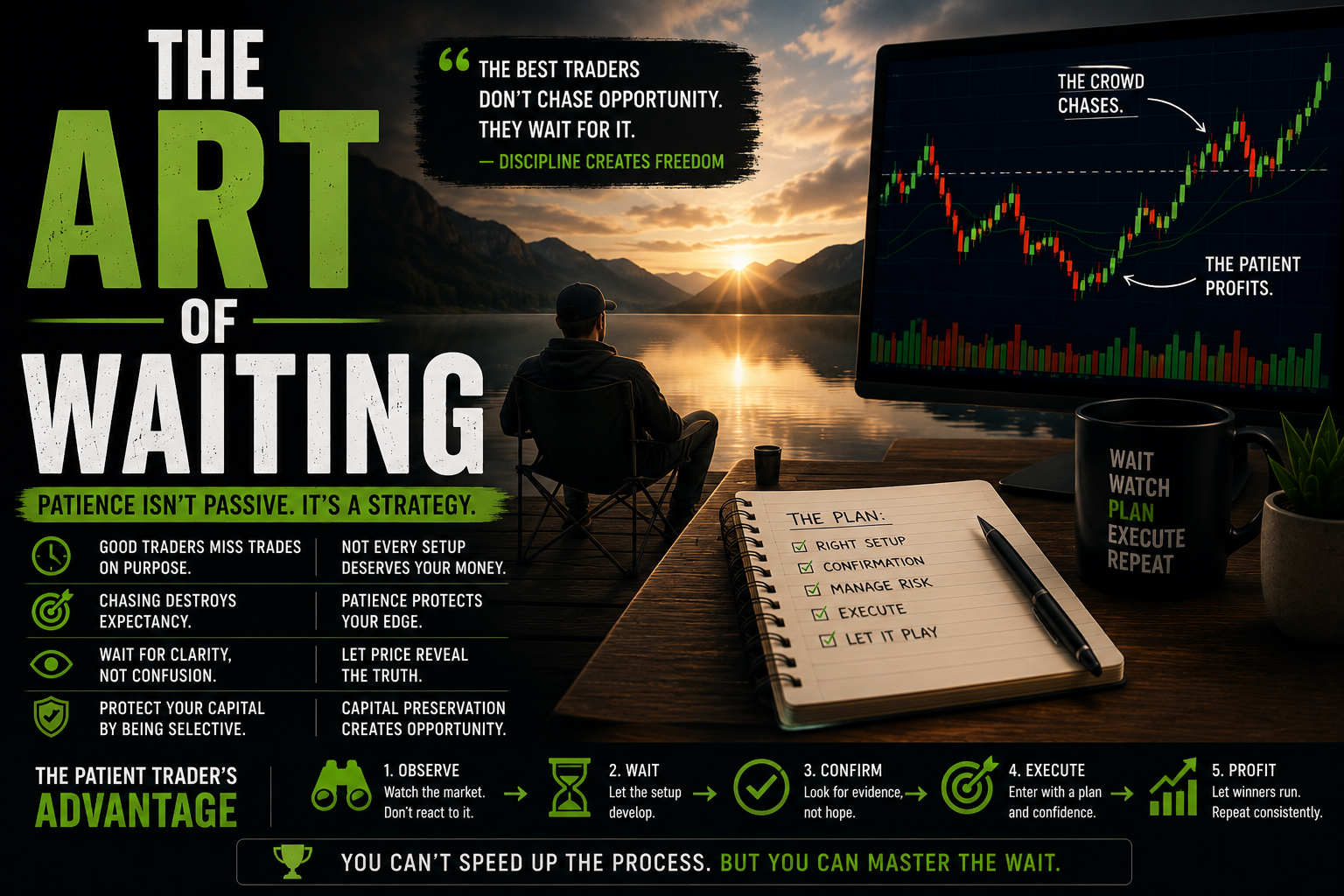
Waiting is not passive.
Waiting is active risk management.
Imagine two traders.
The first takes ten trades.
The second takes three.
Both make the same amount of money.
Who performed better?
The answer is obvious.
The trader who required fewer decisions, less exposure, and less risk achieved the same outcome.
Selectivity matters.
The Hidden Cost of Impatience
Most traders can identify losses.
Few traders identify opportunity cost.
Every poor trade consumes resources.
Capital.
Attention.
Emotional energy.
Confidence.
When traders become impatient, they often enter mediocre setups.
Those mediocre setups frequently prevent them from participating in better opportunities later.
This creates a double loss.
The bad trade loses money.
The missed good trade loses opportunity.
Impatience becomes surprisingly expensive.
What Elite Traders Understand
Elite traders understand something that beginners often overlook.
The market is not paying them for effort.
The market is paying them for judgment.
The ability to identify when not to trade is often more valuable than the ability to identify when to trade.
Think about that for a moment.
The difference between average traders and exceptional traders is often not the trades they take.
It is the trades they refuse to take.
That distinction changes everything.
The Hunter Analogy
Imagine a hunter in the wilderness.
The inexperienced hunter fires at every movement.
The experienced hunter waits.
He studies.
He observes.
He allows the opportunity to develop.
When the moment finally arrives, he acts decisively.
Trading works the same way.
Most traders fire at movement.
Professionals wait for opportunity.
That patience dramatically improves outcomes.
Building Patience
Patience is not something you are born with.
It is a skill.
Like any skill, it can be developed.
Start by tracking every trade you take.
Then ask a simple question:
Was this trade planned?
Or was it impulsive?
You may be surprised by the answer.
Many traders discover that their biggest losses come from trades they never should have taken in the first place.
That awareness becomes the foundation for improvement.
Patience is not about doing nothing.
Patience is about doing nothing until something deserves your attention.
The Paradox of Trading
One of the great paradoxes of trading is that the less you feel the need to trade, the better your trading often becomes.
This seems backwards.
Most industries reward more activity.
More effort.
More production.
More hours.
Trading often rewards restraint.
The ability to wait.
The ability to pass.
The ability to stay patient.
This reality frustrates many people because it feels unnatural.
But markets are not designed around human comfort.
They are designed around probabilities.
Final Thoughts
Most traders believe success comes from finding better trades.
In reality, much of success comes from avoiding bad ones.
Patience is not passive.
Patience is not weakness.
Patience is not hesitation.
Patience is a competitive advantage.
It allows you to avoid emotional decisions.
It allows you to focus on quality opportunities.
It allows you to protect capital.
Most importantly, it allows you to wait for the market to reveal information.
The best traders are not necessarily the smartest traders.
They are often the most patient.
They understand that opportunities come and go.
They understand that missing a trade is not a disaster.
They understand that the market rewards judgment, not activity.
And they understand one of the most important lessons in trading:
You do not chase the market.
You let the market come to you.
Because when patience becomes a skill, trading becomes dramatically simpler.
And simplicity, more often than not, leads to consistency.