
When many traders hear the word automation they immediately become defensive.
They believe automation threatens their role.
They imagine machines replacing human traders entirely.
But this view misunderstands the real purpose of automation.
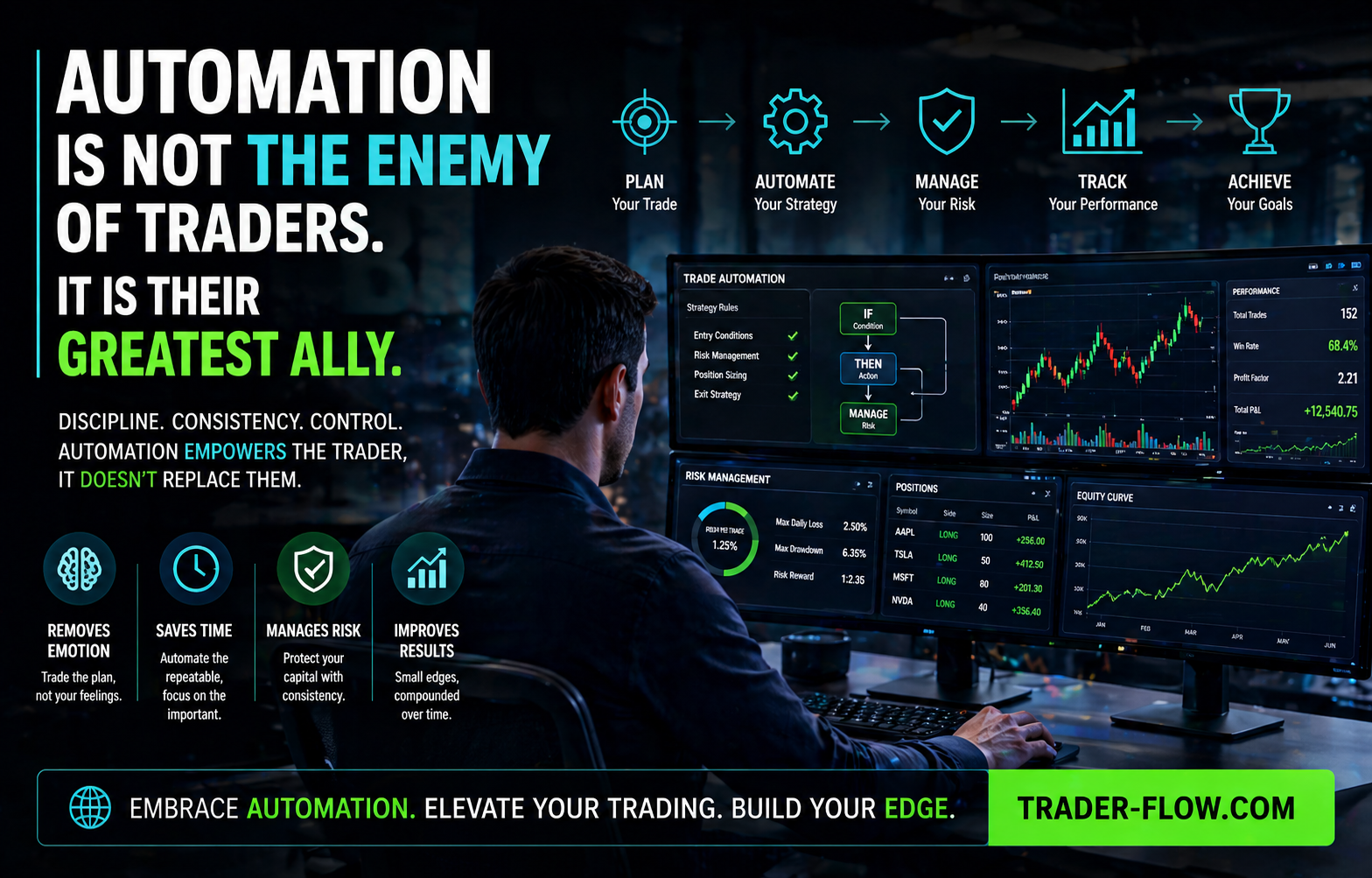
Automation is not about replacing traders.
It is about eliminating mistakes.
In trading, mistakes are expensive.
Small errors in execution can quietly destroy months of hard work.
Automation exists to protect traders from those errors.
And when used properly, it can dramatically improve trading performance.
The Hidden Cost of Human Error
Trading is a profession that demands precision.
Yet most traders rely on highly manual workflows that invite mistakes.
Consider how many decisions a trader must make during a single trade.
Choosing the correct entry price.
Calculating the correct position size.
Determining the correct stop loss.
Managing the trade while it is open.
Recording the trade for future analysis.
Each step involves mental calculation and emotional pressure.
Under stress, even experienced traders can make errors.
A trader might accidentally risk too much capital.
A trader might move a stop loss impulsively.
A trader might exit too early due to fear.
These errors are not caused by lack of intelligence.
They are caused by human psychology.
And psychology is one of the greatest challenges in trading.
Why Psychology Sabotages Traders
Markets are unpredictable.
Prices move quickly.
News creates volatility.
Losses create emotional pressure.
Under these conditions the human brain often shifts into emotional decision making.
Fear can cause traders to exit profitable trades prematurely.
Greed can cause traders to hold losing trades too long.
Frustration can lead to revenge trading.
Even traders with strong strategies can sabotage themselves when emotions take control.
This is why many traders perform well in backtesting but struggle in real time trading.
The difference is psychology.
Automation helps solve this problem.
Automation Creates Discipline
When a system enforces predefined rules, emotional impulses lose their power.
For example, a structured trading system can automatically calculate position size based on risk parameters.
Instead of guessing how many shares to trade, the system ensures that risk remains consistent.
Similarly, a structured workflow can ensure that every trade follows the same process.
Trade idea.
Entry plan.
Stop loss.
Target.
Execution.
This removes much of the impulsive decision making that causes traders to deviate from their plan.
The result is greater discipline.
And discipline is one of the most valuable assets a trader can possess.
Professional Traders Already Use Automation
Some retail traders believe automation is only for algorithmic trading firms.
In reality, professional traders have been using structured trading systems for decades.
Large trading firms build software to help their traders manage risk and execute trades efficiently.
These systems do not replace traders.
They support them.
They enforce rules.
They track performance.
They provide data driven insights.
Retail traders historically lacked access to these tools.
But that is beginning to change.
New platforms are making professional level trading workflows available to individual traders.
Automation Reduces Cognitive Load
One of the biggest advantages of automation is that it reduces cognitive load.
Human attention is limited.
If a trader must constantly calculate position sizes, monitor multiple charts, and track trades manually, mental fatigue builds quickly.
Fatigue leads to mistakes.
Automation removes much of this mental burden.
Instead of performing repetitive calculations, the trader can focus on what truly matters.
Understanding market behavior.
Evaluating trade opportunities.
Managing risk strategically.
Technology handles the mechanical tasks.
The trader focuses on strategy.
The Role of Data in Trading Improvement
Another benefit of automation is improved data tracking.
Most traders understand the importance of journaling.
However many fail to journal consistently because manual journaling is tedious.
Without accurate data, traders cannot properly evaluate their performance.
They cannot identify strengths or weaknesses in their strategy.
Automated trade tracking solves this problem.
Every trade can be recorded automatically.
Performance metrics such as win rate, expectancy, and average risk reward can be analyzed objectively.
Over time this creates a feedback loop that allows traders to improve.
Trading becomes a process of continuous refinement rather than guesswork.
Building a Structured Trading Process
Successful trading requires structure.
A professional trader does not simply open charts and react randomly.
Every trade follows a defined process.
Idea generation
Trade planning
Risk management
Execution
Review
Automation helps enforce this structure.
Instead of relying on memory or discipline alone, the system guides the workflow.
This increases consistency across hundreds or thousands of trades.
And in trading, consistency is the key to long term profitability.
How TraderFlow Brings Automation to Retail Traders
TraderFlow was created with one goal in mind.
To give traders a structured environment that helps eliminate unnecessary mistakes.
TraderFlow integrates several critical components of the trading process.
Market scanning to identify potential opportunities.
Trade planning tools that help define entries, stop losses, and targets.
Automatic risk calculations that ensure position sizes remain consistent.
Trade tracking that records performance data automatically.
Performance analytics that help traders evaluate their strategy.
Instead of relying on scattered tools and manual spreadsheets, traders can operate within a unified workflow.
This creates clarity.
And clarity leads to better decision making.
Automation Does Not Replace Skill
It is important to understand that automation does not replace trading skill.
A poor strategy will still produce poor results.
But automation helps ensure that a good strategy is executed properly.
Think of it like a professional kitchen.
A chef still needs culinary skill.
But modern equipment allows the chef to cook with greater precision and consistency.
Trading works the same way.
Technology enhances skill.
It does not replace it.
The New Standard for Traders
The markets are becoming increasingly competitive.
Institutional traders already operate with advanced tools and data systems.
Retail traders who continue relying on purely manual workflows will find it difficult to keep pace.
Automation is not a threat.
It is an opportunity.
It allows traders to reduce errors, improve discipline, and operate with professional level structure.
And for traders who want to compete in modern markets, that structure is becoming essential.
Ready to Trade With Structure Instead of Emotion
If you are serious about becoming a consistent trader, you cannot rely on willpower alone.
You need systems. You need structure. You need tools that enforce discipline when the pressure is on.
That is exactly why we built TraderFlow.
TraderFlow helps you plan your trades, manage risk, track performance, and execute with precision so you can focus on what matters most: making smart decisions and protecting your capital.
Stop guessing.
Stop reacting.
Start trading like a professional.
See how TraderFlow can transform your trading process:
https://www.trader-flow.com/