Most traders only see the result.
They see the profit.
They see the loss.
They see the R multiple.
They see the account growth.
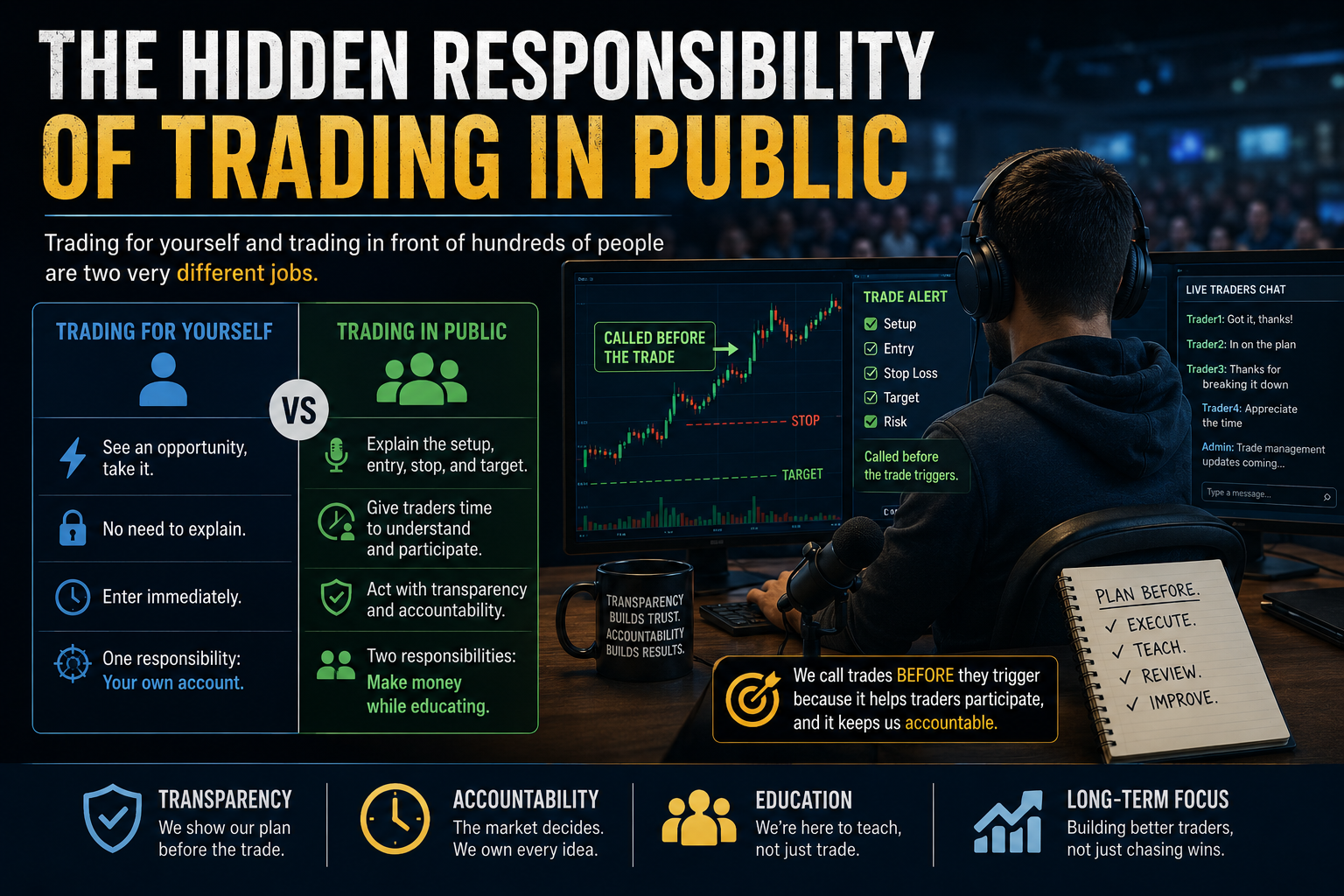
What most people never consider is that there is a significant difference between trading for yourself and trading publicly in front of hundreds of traders.
Those are not the same job.
And they come with very different responsibilities.
Trading for Yourself
Earlier in my career, I traded exclusively for myself.
Like many traders coming up through the prop firm environment, my focus was simple:
Find opportunities.
Execute well.
Manage risk.
Make money.
During those years, there were months where I generated 40R, 50R, and even 60R.
My account was smaller.
My risk was smaller.
Most importantly, I only had one responsibility:
My own trading.
If I saw a setup, I could enter immediately.
I didn’t need to explain it.
I didn’t need to announce it.
I didn’t need to wait for anyone else.
I simply executed.
The market moved.
I reacted.
The trade either worked or it didn’t.
That was the entire job.
Trading and Teaching Are Different Jobs
Everything changes when you begin trading publicly.
The responsibility is no longer just making money.
The responsibility becomes:
Making money while educating.
A trade is no longer just about execution.
Now it must also be communicated clearly.
Before the trade happens, traders need to understand:
- The setup
- The entry
- The stop loss
- The target
- The risk
And perhaps most importantly, they need enough time to process the information and make their own decision.
This creates a challenge that individual traders never have to think about.
A trader operating alone can simply react.
An educator must communicate.
A trader operating alone only needs to be right.
An educator needs to be clear.
Those are very different responsibilities.
Why We Call Trades Before They Trigger
Over the years, we’ve developed a simple philosophy at LiveTraders:
A trade should be called before it happens, not after.
At first glance, that may sound obvious.
But in today’s trading education industry, it is surprisingly common to see traders discuss opportunities only after the move is already underway.
The problem with that approach is that it creates a gap between what is being reported and what is realistically executable.
At LiveTraders, our goal has never been to impress traders with hindsight.
Our goal is to teach traders how to think before the trade occurs.
That means identifying:
- The setup
- The entry
- The stop loss
- The target
- The risk
before the trade triggers.
This philosophy serves two important purposes.
First, it gives traders a realistic opportunity to evaluate the setup and participate if they choose.
Second, and perhaps more importantly, it creates accountability.
When a trade is called before it triggers, there is nowhere to hide.
The market will determine whether the idea was correct.
The trade either works or it doesn’t.
The outcome becomes transparent.
As educators, that accountability matters.
Anyone can point to a chart after a stock has already moved and identify an opportunity.
The real challenge is identifying the opportunity before the move occurs.
That is where preparation, experience, and discipline matter.
Accountability Changes Everything
One of the biggest differences between private trading and public trading is accountability.
When you’re trading your own account, nobody sees your process.
Nobody sees the opportunities you considered but never mentioned.
Nobody sees the trades you almost took.
Nobody sees the ideas that failed.
But when you’re teaching publicly, every idea is exposed.
Every setup is visible.
Every entry is visible.
Every stop is visible.
Every outcome is visible.
That level of transparency creates a different standard.
In many ways, it forces you to become a better trader and a better educator.
Because once you commit to calling trades before they happen, you can no longer rely on hindsight.
You have to trust your preparation.
You have to trust your process.
You have to let the market decide whether you are right or wrong.
Not Every Trade Can Be Called
One of the realities of trading in real time is that markets move fast.
Sometimes a setup appears and immediately starts moving.
As an individual trader, you can simply jump in.
When you’re teaching, the situation is different.
You have to ask:
Can people realistically get this entry?
Can I explain the trade properly?
Can I communicate the risk clearly?
Can traders understand what they’re doing?
Can they make an informed decision?
By the time all of that happens, part of the move may already be gone.
That is simply part of the responsibility that comes with trading publicly.
Many traders never experience this challenge because they are only responsible for their own execution.
Educators carry an additional responsibility.
The goal is not simply to take trades.
The goal is to help others learn how to take trades.
Professional Trading Evolves
Another misconception many traders have is that every stage of a trading career should look the same.
It doesn’t.
The way a trader operates with a small account is often very different from the way they operate with a larger account.
The way someone trades for themselves is often very different from the way they trade while educating others.
As traders grow, they begin thinking less like trade-takers and more like capital allocators.
They begin managing:
- Day trades
- Swing trades
- Long-term investments
- Options positions
- Covered calls
- Portfolio risk
The focus shifts from maximizing action to maximizing overall returns.
The goal is no longer to find the most trades.
The goal is to make the best decisions with the capital available.
The Goal Is Bigger Than One Trade
When traders compare performance, they often focus on individual trades, individual setups, or individual months.
But professional trading is bigger than that.
The real objective is to develop a process that can survive for years.
A process that can scale.
A process that protects capital.
A process that manages emotions.
A process that can be taught and repeated.
Trading for yourself is challenging.
Trading while educating others introduces an entirely different layer of responsibility.
Neither is better.
Neither is worse.
But they are very different jobs.
And understanding that distinction is important for anyone evaluating trading performance.
Because at the professional level, success is not just about making money.
It’s about making money while maintaining discipline, transparency, consistency, accountability, and trust.
That is the hidden responsibility of trading in public.