
The Lie That Costs Traders Millions
Most people enter trading looking for excitement.
They want action.
They want fast money.
They want the adrenaline rush of catching a huge move.
They want stories.
They want screenshots.
They want trades they can brag about.
What they usually don’t want is boring.
Unfortunately, the market has an interesting sense of humor.
The very thing most traders avoid is often the thing that creates the most consistent profits.
Boring.
Simple.
Predictable.
Repeatable.
The longer I trade, the more convinced I become that the biggest difference between profitable traders and struggling traders isn’t intelligence.
It isn’t work ethic.
It isn’t even technical knowledge.
It’s their relationship with boredom.
Successful traders learn to embrace it.
Losing traders spend their careers trying to avoid it.
Why Excitement Is Dangerous
Think about the trades that generate the most attention.
A stock gaps up 30%.
A biotech doubles overnight.
A meme stock explodes.
A short squeeze sends prices vertical.
Social media lights up.
Everyone is talking about it.
Everyone wants in.
It feels exciting.
The problem is that excitement often means uncertainty.
The more emotional a situation becomes, the more difficult it becomes to make rational decisions.
When emotions rise, discipline falls.
When discipline falls, mistakes increase.
This is why so many traders find themselves chasing the exact trades that eventually hurt them.
They mistake excitement for opportunity.
The market does not pay extra because a trade was exciting.
The market pays based on execution.
The Professional’s Secret
If you could watch most successful traders every day, you would probably be disappointed.
There are no dramatic speeches.
There are no heroic predictions.
There are no movie scenes.
Most professional trading looks surprisingly ordinary.
They identify a setup.
They wait.
They enter.
They manage risk.
They exit.
Then they do it again.
And again.
And again.
The process is repetitive.
The process is boring.
The process works.
The public imagines professional traders making bold predictions and dramatic trades.
The reality is often far less glamorous.
Most professionals spend far more time waiting than trading.
The Problem With Looking for Home Runs
Many traders enter the market looking for the next huge winner.
They want the stock that doubles.
They want the trade that changes everything.
They want life changing profits from a single position.
The market occasionally provides those opportunities.
But building an entire trading career around finding them is dangerous.
Imagine owning a restaurant.
Would you rather:
Make a small profit from thousands of customers every year?
Or depend on one customer showing up and spending a million dollars?
The answer is obvious.
Yet traders often do the opposite.
They build strategies around rare outcomes instead of repeatable outcomes.
Consistency beats excitement.
Always.
Why Ordinary Patterns Work
One of the hardest concepts for newer traders to accept is that the market tends to behave similarly over and over again.
Human nature doesn’t change.
Fear doesn’t change.
Greed doesn’t change.
Supply and demand don’t change.
As a result, certain patterns appear repeatedly.
Stocks pull back.
Stocks consolidate.
Stocks trend.
Stocks break out.
Stocks retrace.
This behavior is normal.
The best traders learn how to profit from these ordinary movements.
They don’t need extraordinary situations.
They simply need repeatable ones.
The Difference Between Probability and Possibility
Every trader eventually faces a choice.
Do you want to trade possibilities?
Or probabilities?
A possibility is something that can happen.
A probability is something that is likely to happen.
The problem is that possibilities are often more exciting.
A stock could double.
A stock could squeeze.
A stock could explode.
A stock could become the next big thing.
All true.
But how likely is it?
Professional traders focus on probability.
Not possibility.
That subtle distinction changes everything.
Why Most Traders Buy Too Late
One of the most common mistakes in trading is entering after a move already becomes obvious.
Price begins moving higher.
The trader notices.
Price moves even higher.
The trader becomes interested.
Price continues higher.
The trader becomes excited.
Finally, the trader enters.
Unfortunately, the move is often nearing completion.
The trader wasn’t buying opportunity.
The trader was buying confirmation.
And confirmation usually costs money.
The market rewards anticipation.
The crowd rewards confirmation.
Those are rarely the same thing.
The Comfort Trap
Human beings naturally seek comfort.
We want reassurance.
We want agreement.
We want evidence.
Unfortunately, profitable trading often requires acting before comfort arrives.
By the time everyone agrees a stock looks good, much of the opportunity may already be gone.
The safest feeling trades are often the most crowded trades.
And crowded trades create risk.
This is why professionals frequently enter positions when things still feel relatively boring.
They understand that opportunity often exists before excitement.
The Power of Simplicity
One of the most overlooked advantages in trading is simplicity.
Many traders believe complexity creates edge.
They add indicators.
They add algorithms.
They add filters.
They add rules.
They add conditions.
Eventually they create a system so complicated that they can barely use it.
The irony is that markets are already complex.
Your process doesn’t need to be.
Simple setups are easier to recognize.
Simple setups are easier to execute.
Simple setups are easier to repeat.
Complexity often creates confusion.
Simplicity creates consistency.
The Business Analogy
Imagine two business owners.
The first owns a company that generates a small profit every day.
The second owns a company that loses money most days but occasionally produces a massive windfall.
Which business would you rather own?
Most people choose the first.
Yet many traders build their trading around the second.
They seek occasional jackpots.
They ignore consistency.
They focus on excitement instead of sustainability.
Professional traders think like business owners.
Every trade is simply another business decision.
Consistency matters.
Longevity matters.
Risk management matters.
Excitement does not.
Why Longevity Is Everything
One of the most important words in trading is longevity.
Can you survive?
Can you stay in the game?
Can you continue trading next month?
Next year?
Five years from now?
Many traders experience periods of success.
Few maintain it.
The reason is often simple.
They become addicted to excitement.
They increase size.
They take unnecessary risks.
They abandon their process.
Eventually the market reminds them who is in charge.
Longevity requires discipline.
Longevity requires humility.
Longevity requires consistency.
Most importantly, longevity requires accepting boredom.
What Real Confidence Looks Like
New traders often confuse confidence with aggression.
They think confident traders take huge positions.
They think confident traders predict market direction.
They think confident traders trade constantly.
Real confidence looks different.
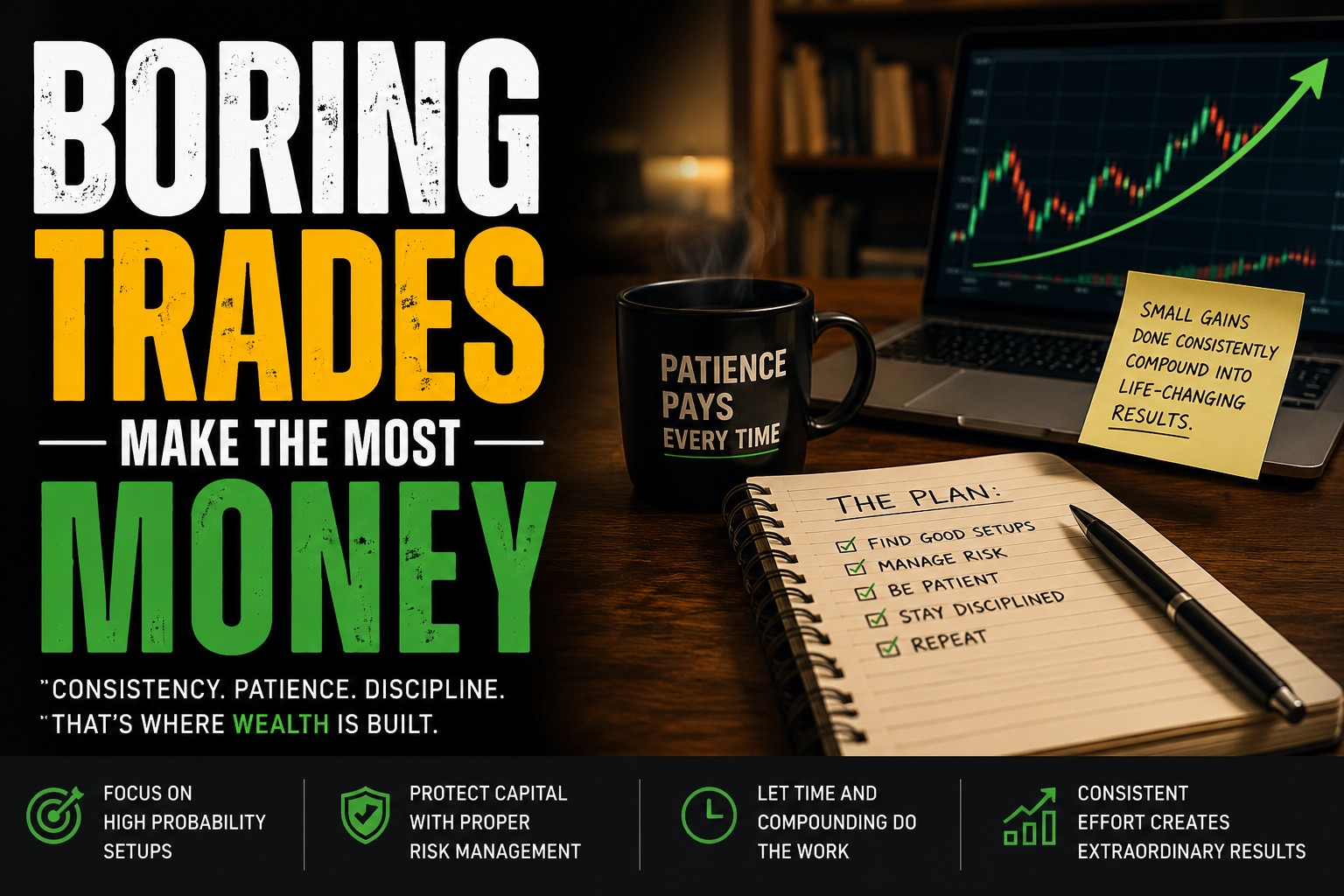
Real confidence is following your process even when it feels boring.
Real confidence is waiting for your setup.
Real confidence is ignoring noise.
Real confidence is passing on mediocre opportunities.
Real confidence is consistency.
Anything else is often just ego.
The Compound Effect
One of the greatest forces in finance is compounding.
Small gains accumulate.
Consistent gains accumulate.
Disciplined gains accumulate.
Imagine earning a modest return repeatedly over many years.
The results become extraordinary.
Now imagine chasing excitement.
Huge gains followed by huge losses.
Periods of success followed by periods of destruction.
The long term results are often disappointing.
Compounding rewards consistency.
Not drama.
Not excitement.
Not heroics.
Consistency.
The Hidden Advantage of Boring Trades
Boring trades provide something valuable.
Clarity.
When a setup is simple, you know exactly why you entered.
You know exactly where you’re wrong.
You know exactly where your target is.
You know exactly how much you’re risking.
Decision making becomes easier.
Emotions become smaller.
Execution improves.
This clarity creates confidence.
And confidence improves performance.
Not because the trade is guaranteed.
But because the process is clear.
The Reality Most Traders Eventually Learn
Most traders begin their careers looking for extraordinary opportunities.
Most successful traders eventually realize they don’t need them.
They need ordinary opportunities executed extraordinarily well.
That realization changes everything.
Suddenly the focus shifts.
Instead of searching for excitement, they search for quality.
Instead of chasing movement, they wait for setups.
Instead of forcing trades, they become selective.
The market rewards this behavior.
Consistently.
Final Thoughts
The greatest irony in trading is that the trades most people find boring are often the trades that build long term success.
Simple setups.
Repeatable patterns.
Clear entries.
Defined risk.
Manageable expectations.
Nothing flashy.
Nothing dramatic.
Nothing exciting.
Just probability.
Most traders spend years searching for the secret.
The secret is often hiding in plain sight.
The market does not require brilliance.
The market does not require heroics.
The market does not require constant action.
The market rewards discipline.
The market rewards patience.
The market rewards consistency.
And consistency is usually boring.
The sooner you learn to appreciate that truth, the sooner your trading begins to change.
Because while everyone else is chasing excitement, the professional is quietly building wealth one high probability trade at a time.