

One of the most dangerous habits traders develop has nothing to do with charts, indicators, or market conditions.
It happens after the market closes.
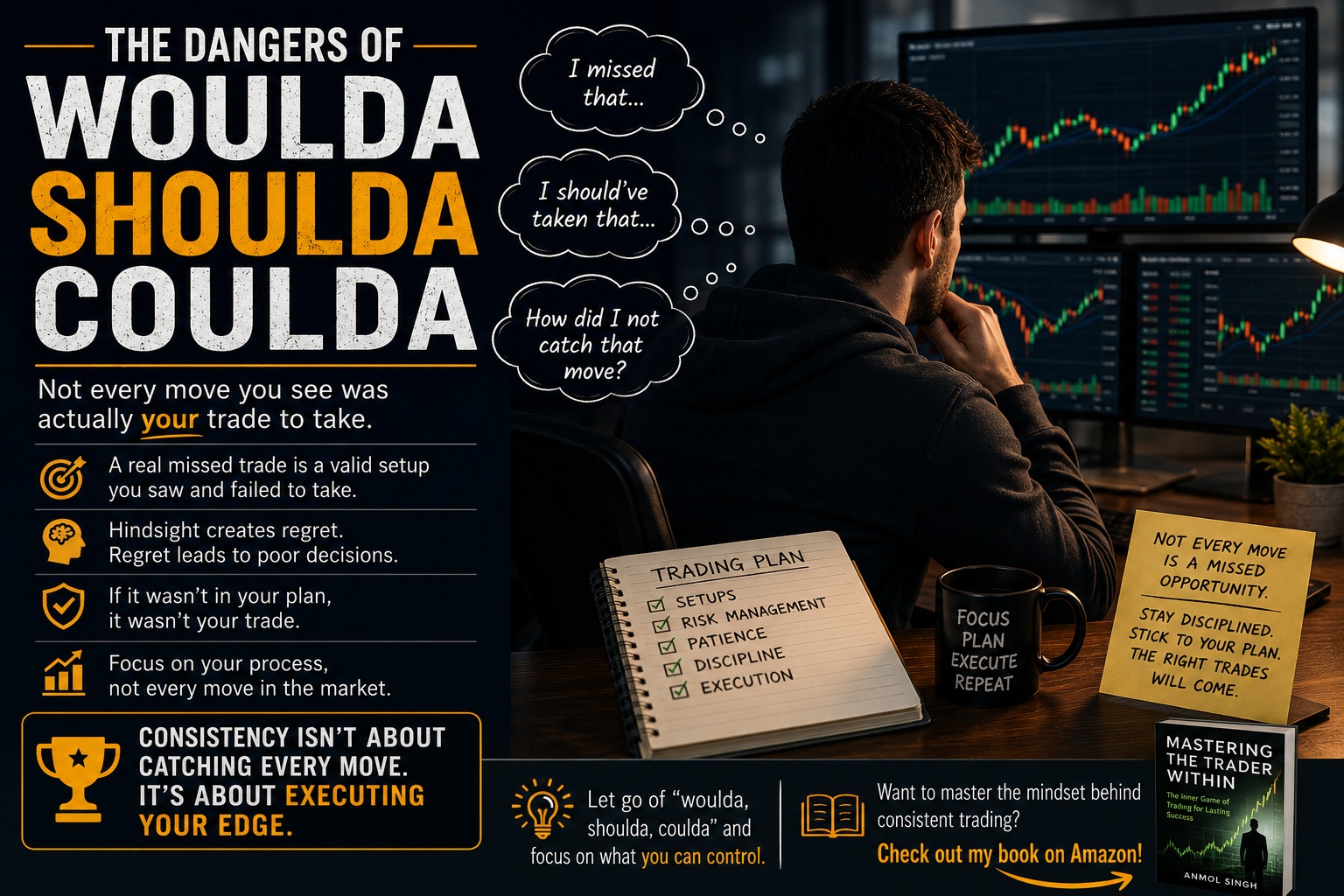
You sit down, scroll through charts, and suddenly every move looks obvious. You see stocks that exploded higher or collapsed lower and immediately think:
“I missed that.”
“I should’ve taken that.”
“How did I not catch that move?”
At first, this may seem harmless. But over time, this mindset can quietly destroy your confidence, discipline, and consistency as a trader.
The truth is, not every move you see was actually your trade to take.
And understanding that distinction can completely change your psychology as a trader.
What Is a Real Missed Trade?
Let’s use day trading as an example, although this applies equally to swing trading and investing.
At the end of the day, it is very easy to look back at charts and label every big move as a missed opportunity. But here’s the question you need to ask yourself:
If you had been sitting at your desk in real time, would you have actually taken that trade based on your rules, setup, and plan?
That is the real test.
There is a massive difference between:
“Wow, that was a great move.”
and
“That was a valid setup according to my system, I saw it in real time, and I failed to execute.”
Only the second one is truly a missed trade.
A stock moving without you does not automatically mean you made a mistake.
The Psychological Trap
When traders constantly replay charts in hindsight, they start creating an illusion that they are always behind the market.
This creates frustration.
Then regret.
Then emotional pressure.
Eventually, many traders begin forcing trades simply because they do not want to “miss” another move.
That is where discipline starts breaking down.
You start chasing entries.
Taking setups outside your plan.
Overtrading.
Ignoring risk management.
All because of trades that may never have belonged to your strategy in the first place.
The market will always produce opportunities you are not involved in. That is normal. No trader catches every move, nor should they try to.
Professional trading is not about catching everything.
It is about consistently executing your edge.
Was It Actually Your Trade?
Here are a few important questions to ask yourself before labeling something a missed trade:
• Did the setup match your strategy?
• Was it within your trading plan?
• Were you even available to take it properly?
• Did it meet your risk parameters?
• Would you realistically have executed it in real time?
If the answer is no to those questions, then it was not truly a missed trade.
It was simply a move that happened without you.
That may sound like a small distinction, but psychologically, it is a massive one.
Because one creates unnecessary emotional baggage.
The other creates clarity and objectivity.
Reviewing Trades vs. Regretting Trades
Now, this does not mean you should avoid reviewing charts or analyzing trades afterward.
In fact, reviewing your trading is essential for improvement.
The best traders constantly study:
• Their executions
• Their missed opportunities
• Their patterns
• Their mistakes
• Their decision making
But there is a difference between constructive review and emotional hindsight.
Constructive review asks:
“What can I learn from this?”
Emotional hindsight says:
“I can’t believe I missed that.”
One leads to growth.
The other leads to frustration.
You should absolutely review whether there were setups you consistently overlooked or patterns you need to improve at recognizing. That is part of developing as a trader.
But you should not rewrite your entire strategy or emotionally spiral because of one chart you noticed after the fact.
Final Thoughts
Trading already carries enough emotional pressure on its own.
There is no reason to add more by punishing yourself over moves that were never truly yours to take.
The market will always offer another opportunity.
There will always be another setup.
Another breakout.
Another trend.
Your job is not to catch every move.
Your job is to stay disciplined, execute your edge, and focus on the trades that actually belong to your system.
That is how consistency is built.
Not through “woulda, shoulda, coulda.”
But through clarity, process, and execution.
Want to Improve Your Trading Psychology?
Most traders spend years trying to master charts, indicators, and strategies, while completely overlooking the biggest factor behind long term success: their mindset.
If you enjoyed this article and want to go deeper into the psychology, discipline, emotional control, and habits required to become a consistently profitable trader, check out my book, Mastering the Trader Within.
Inside, I break down the mental frameworks, emotional patterns, and real world lessons that helped me grow not just as a trader, but as a person.
Whether you are struggling with overtrading, fear, inconsistency, revenge trading, or self sabotage, this book was written to help you understand the trader behind the trades.
You can grab your copy here: