There was a time when retail traders had a significant advantage.
Markets moved slower.
Information traveled slowly.
Competition was limited.
A skilled trader could analyze charts and execute trades manually with relatively little technological support.
That world no longer exists.
Today the financial markets are among the most technologically advanced environments on earth.
High frequency trading firms operate powerful systems capable of analyzing massive amounts of market data in milliseconds.
Institutional traders rely on advanced analytics and execution platforms.
Artificial intelligence models are now being applied to market analysis.
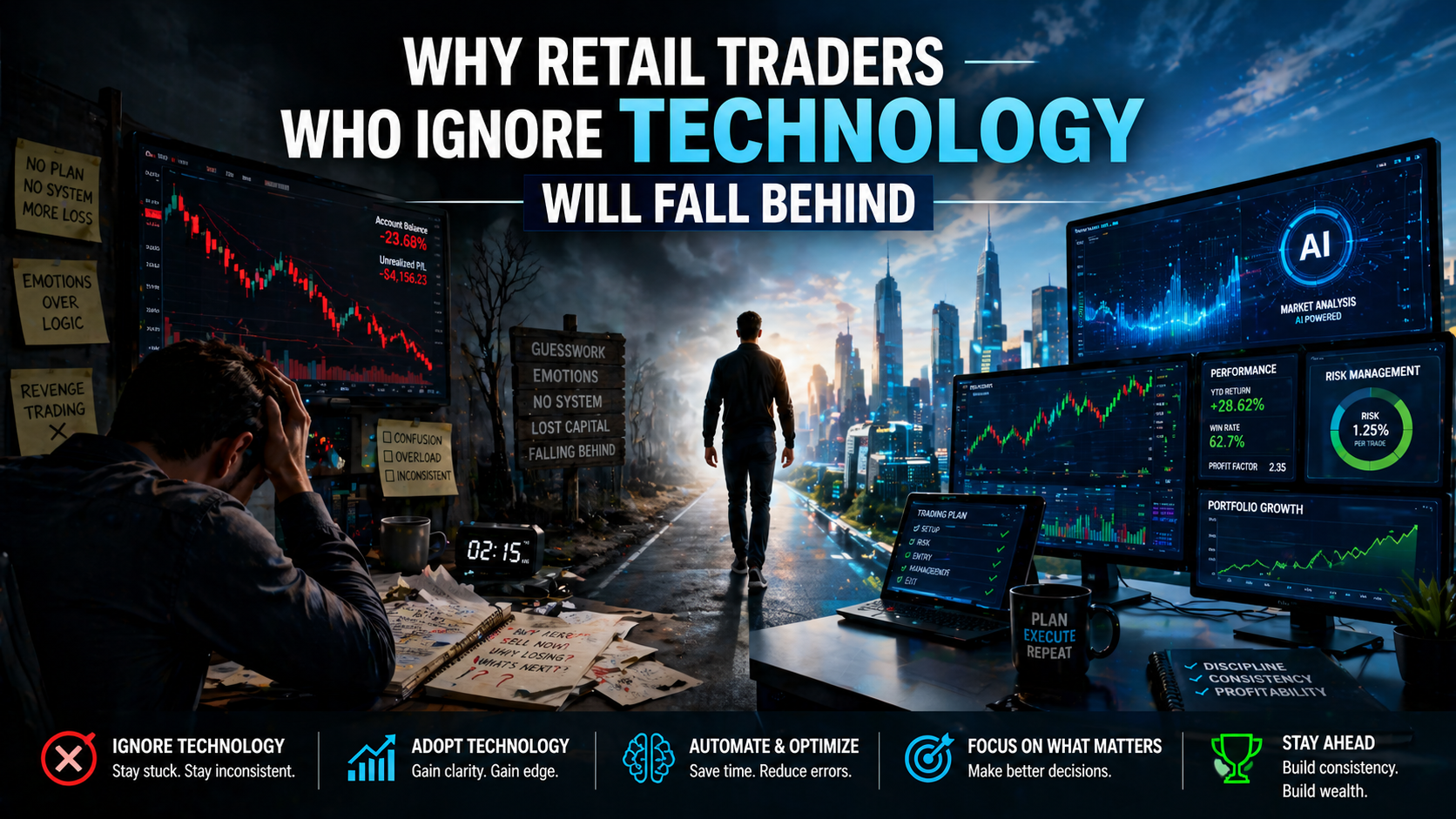
In this environment, traders who refuse to adopt modern tools face a serious challenge.
Technology is no longer optional.
It is becoming a requirement.
The Evolution of Market Competition
Every industry evolves through technological progress.
Agriculture evolved with mechanized equipment.
Manufacturing evolved with automation and robotics.
Transportation evolved with advanced navigation systems.
Financial markets are undergoing the same transformation.
Competition is increasing.
Data is expanding.
Execution speeds are accelerating.
Retail traders who rely purely on manual processes are competing against participants who operate with sophisticated technology.
This does not mean retail traders cannot succeed.
But it does mean they must evolve.
The Myth of the Lone Trader
Many people romanticize the idea of the lone trader sitting in front of charts and conquering the markets through intuition alone.
While intuition can be valuable, professional trading is rarely that simple.
Institutional traders operate within structured environments.
They have risk management systems.
They have performance analytics.
They have execution tools.
These systems help ensure that trades are executed consistently and that risk remains controlled.
Retail traders often lack this structure.
Instead they rely on memory, spreadsheets, and fragmented tools.
This creates unnecessary inefficiencies.
Technology can solve that problem.
Information Overload
Another challenge modern traders face is information overload.
Thousands of stocks trade every day.
News events occur constantly.
Market conditions change rapidly.
Attempting to process all of this information manually is overwhelming.
Technology helps filter and organize data.
Market scanning tools can highlight opportunities that match specific criteria.
Analytics platforms can reveal patterns in trading performance.
Automation can reduce repetitive tasks.
The trader remains the decision maker.
But technology simplifies the information landscape.
The Power of Data Driven Improvement
One of the greatest advantages of modern trading technology is the ability to collect and analyze data.
Professional traders understand that performance improvement requires measurement.
Without data, improvement becomes guesswork.
By tracking trades systematically, traders can analyze important metrics.
Which setups produce the best results.
Which market conditions produce losses.
How risk reward ratios affect profitability.
This type of analysis allows traders to refine their strategy over time.
Technology makes this process far more efficient.
The Rise of Hybrid Trading
The future of trading will not be purely discretionary and it will not be purely automated.
Instead we are seeing the emergence of hybrid trading.
In this model, human traders make strategic decisions while technology assists with analysis and execution.
The human mind remains responsible for interpreting market behavior.
Technology handles repetitive calculations and data processing.
This partnership between human intelligence and technological efficiency creates a powerful combination.
Traders who adopt this model gain a significant advantage.
Building a Professional Trading Workflow
A professional trading workflow typically involves several stages.
Market scanning to identify potential opportunities.
Trade planning to determine entry, stop loss, and target.
Risk management to calculate position size.
Execution through a trading platform.
Post trade analysis to evaluate performance.
When these steps are performed manually, the process becomes slow and error prone.
Technology can integrate these stages into a seamless workflow.
This improves efficiency and consistency.
The Emergence of TraderFlow
TraderFlow was designed to help traders operate within this modern framework.
Instead of piecing together multiple tools, TraderFlow creates a structured trading environment.
It assists traders with identifying opportunities, planning trades, managing risk, and analyzing results.
By bringing these functions together, the platform reduces friction and helps traders focus on strategic decision making.
The goal is not to automate trading completely.
The goal is to help traders execute their strategy with greater precision and consistency.
The Competitive Reality
The markets are not becoming easier.
Competition is increasing.
Technology is advancing.
Traders who adapt will gain new capabilities.
Traders who resist change may find themselves at a disadvantage.
This pattern has occurred throughout history in every technological transformation.
The individuals who embrace innovation often lead the next generation of their industry.
The same principle applies to trading.
The Next Generation of Traders
The next generation of successful traders will combine several key qualities.
Strong understanding of market behavior.
Clear trading strategies.
Structured risk management.
And intelligent use of technology.
Those who combine these elements will operate with a significant advantage.
Trading will become less about reacting emotionally and more about executing a well defined process.
Technology will not replace traders.
But it will empower those who know how to use it.
And platforms like TraderFlow represent the beginning of that transformation.
Your Edge Is Not the Setup. Your Edge Is the Process.
Anyone can find a stock.
Very few traders can execute consistently.
Very few traders can manage risk properly.
Very few traders can remove emotion from their decisions.
That is where TraderFlow comes in.
It is not about replacing the trader.
It is about strengthening the trader.
It helps you turn good ideas into consistent execution.
And consistency is what builds long term success in the markets.
Take control of your trading workflow today:
https://www.trader-flow.com/