
Why Most Price Movement Is Noise and Why That Should Make You a Better Trader
One of the most important questions any trader can ask is surprisingly simple:
Can the stock market actually be predicted?
At first glance, the answer seems obvious.
Millions of people trade for a living.
Hedge funds exist.
Trading firms exist.
Professional traders exist.
If markets could not be predicted in some way, none of those people would have jobs.
Yet there is a famous theory that says exactly the opposite.
It is called the Random Walk Theory.
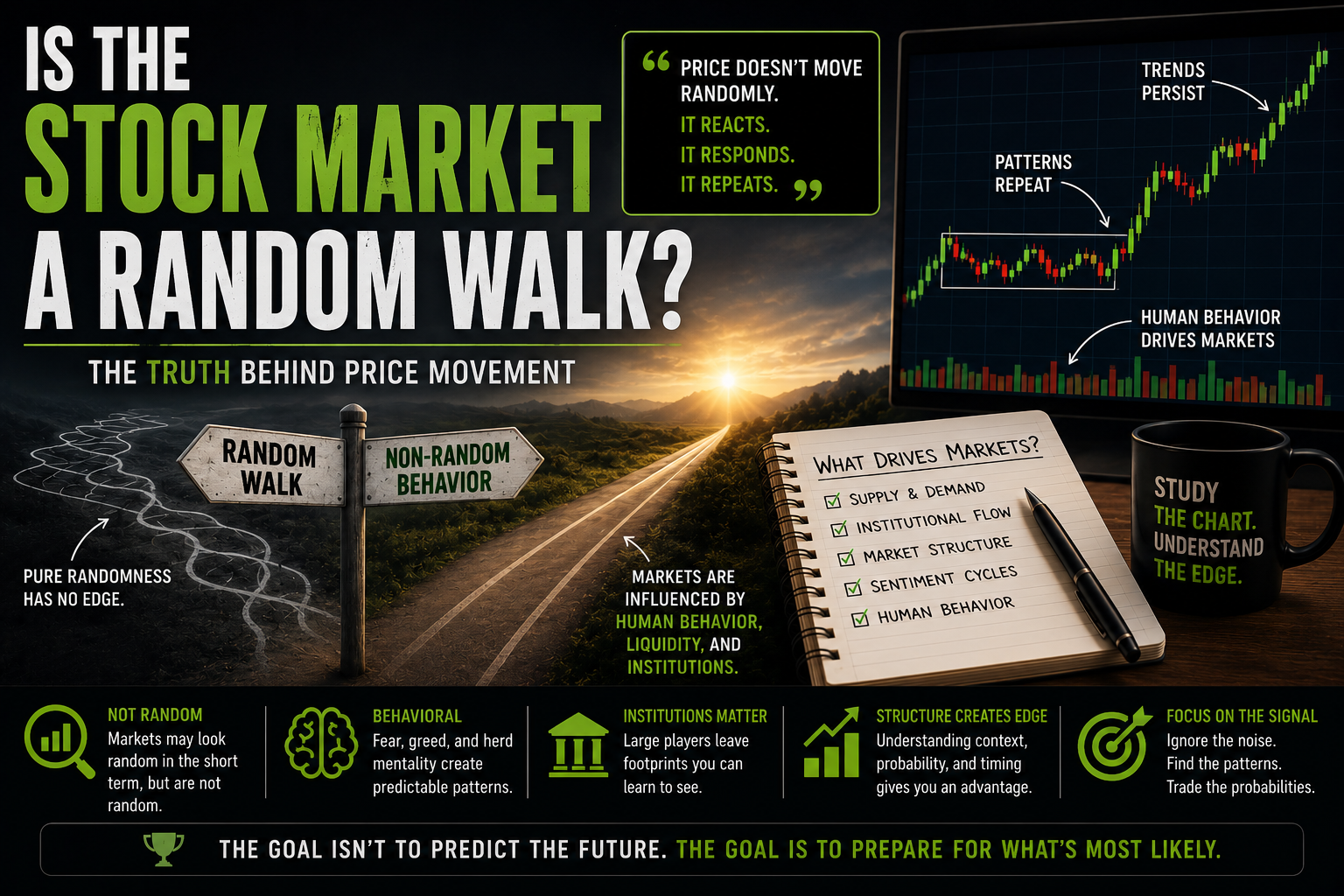
The theory suggests that stock prices move randomly and that future price movements cannot be reliably predicted from past price movements.
In simple terms, the market is supposedly no more predictable than a coin flip.
If that sounds ridiculous, you’re not alone.
Most traders immediately reject the idea.
I did too.
Then I spent years watching charts.
And eventually I realized something interesting.
The theory is not completely wrong.
In fact, understanding where the theory is right may be one of the biggest advantages a trader can have.
Why Most Traders Look for Certainty
When people first enter the markets, they assume every price movement means something.
A stock moves higher.
They search for a reason.
A stock moves lower.
They search for a reason.
A stock pauses.
They search for a reason.
They assume every candle contains valuable information.
Every pullback must have meaning.
Every breakout must be significant.
Every reversal must be important.
The reality is far less exciting.
Most price movement is noise.
Most candles mean absolutely nothing.
Most intraday fluctuations are random.
Most movements occur because buyers and sellers are constantly interacting.
That interaction creates an endless stream of small movements that are often impossible to interpret accurately.
This is where traders get into trouble.
They attempt to find meaning where none exists.
The Casino Analogy
Imagine walking through a casino.
Hundreds of slot machines are spinning.
Thousands of cards are being dealt.
Dice are rolling.
Roulette wheels are spinning.
Random outcomes are occurring everywhere.
Now imagine someone standing beside a roulette table claiming they can predict every spin.
You would probably laugh.
Yet many traders do something remarkably similar.
They stare at every candle and convince themselves they know exactly what comes next.
The market doesn’t work that way.
Professional traders understand that uncertainty is part of the game.
The goal is not certainty.
The goal is probability.
This is a distinction that changes everything.
The Hidden Truth About Trading
Most people think successful traders predict markets.
They don’t.
Successful traders identify situations where probabilities become skewed.
That is a very different skill.
Imagine flipping a coin.
Normally you have a 50 percent chance of heads and a 50 percent chance of tails.
Now imagine someone shows you evidence that the coin has been weighted.
Suddenly the probabilities have changed.
You still cannot know the next outcome.
But you now possess an advantage.
Trading works the same way.
Most of the time markets behave randomly.
Then occasionally something happens.
The chart begins behaving differently.
Price starts revealing unusual strength.
Or unusual weakness.
That is where opportunity exists.
Why Randomness Is Actually Good News
Many traders hear the phrase random walk and become discouraged.
They assume it means making money is impossible.
In reality, it means the opposite.
If everything were perfectly predictable, everyone would be rich.
Every opportunity would disappear instantly.
The reason opportunities exist is because markets are imperfect.
Human beings are emotional.
Institutions accumulate positions.
Fear creates overreactions.
Greed creates excesses.
Mispricing occurs.
All of these things create temporary inefficiencies.
These inefficiencies create opportunity.
The challenge is learning to identify them.
The Difference Between Normal and Abnormal
One of the biggest breakthroughs in my trading career came when I stopped trying to analyze everything.
Instead, I started looking for abnormal behavior.
Most charts are not interesting.
Most charts are ordinary.
Most charts are random.
The greatest opportunities often appear when a chart stops behaving normally.
For example:
A stock gaps down significantly.
Everyone expects continued selling.
Instead buyers immediately step in.
The stock refuses to decline.
That is abnormal.
Or perhaps a stock has been consolidating quietly for weeks.
Volume suddenly increases dramatically.
Every pullback is bought aggressively.
The stock refuses to break down.
That is abnormal.
The key is not predicting every stock.
The key is identifying the few that stand out.
What Institutional Buying Looks Like
Imagine a stock that has been falling for months.
Every rally fails.
Every bounce gets sold.
The chart looks terrible.
Then one day something changes.
The stock gaps lower again.
Everyone expects another decline.
Instead, buyers appear.
The stock finishes near its highs.
The next day it refuses to pull back.
The following day buyers appear again.
Something is different.
Large institutions rarely announce their intentions.
But they leave footprints.
Those footprints appear on charts.
Not because charts are magical.
But because buying pressure eventually becomes visible.
The chart begins telling a story.
The story is not certainty.
The story is probability.
Why Traders Miss These Opportunities
The answer is simple.
They are distracted.
Most traders spend their time searching for certainty.
They want confirmation.
They want guarantees.
They want proof.
Unfortunately, the market never provides those things.
By the time certainty arrives, the move is usually over.
The best opportunities often feel uncomfortable.
The evidence is incomplete.
The setup is developing.
The probabilities are improving.
But certainty never arrives.
This is where experience matters.
Experienced traders learn to act when probabilities favor them.
Not when certainty appears.
The Fishing Analogy
Think of trading like fishing.
A fisherman does not cast his line randomly into every body of water.
He searches for areas where fish are more likely to be present.
He still cannot guarantee a catch.
But he improves his odds.
That is exactly what traders do.
Most stocks are random ponds.
Some stocks contain fish.
The skill lies in recognizing the difference.
Once you understand this concept, your entire approach changes.
You stop trying to trade everything.
You stop trying to predict everything.
You stop forcing opportunities.
Instead, you become selective.
You become patient.
You become focused.
Why Patience Becomes Your Greatest Asset
One of the hardest lessons for traders to learn is that doing nothing is often the correct decision.
Most traders believe activity equals productivity.
It doesn’t.
The market rewards selectivity.
If most charts are random, then most charts should be ignored.
Read that again.
If most charts are random, then most charts should be ignored.
This realization immediately reduces unnecessary trades.
It reduces emotional decisions.
It reduces overtrading.
Most importantly, it allows you to focus your attention where it belongs.
On the charts that actually matter.
The Trap of Constant Action
New traders often feel compelled to trade every day.
They believe sitting in cash means they are failing.
They believe activity equals progress.
The market teaches a different lesson.
Some days provide incredible opportunities.
Other days provide very little.
The ability to recognize the difference is crucial.
Many of the largest losses traders experience come from forcing trades on days when nothing truly stands out.
The best traders are often the most selective traders.
What This Means For Your Trading
The goal is not to become an expert predictor.
The goal is to become an expert observer.
Observe price.
Observe volume.
Observe relative strength.
Observe relative weakness.
Observe unusual behavior.
Look for charts that seem unable to hide what is happening beneath the surface.
Look for stocks that continue rising when they should fall.
Look for stocks that continue falling when they should rise.
Those are clues.
Those are footprints.
Those are opportunities.
The Professional Mindset
Professionals approach markets differently than beginners.
Beginners ask:
“What is the market going to do?”
Professionals ask:
“What is the market currently doing?”
Beginners seek certainty.
Professionals seek probabilities.
Beginners focus on predictions.
Professionals focus on risk.
Beginners trade opinions.
Professionals trade evidence.
This difference appears small.
In reality, it is enormous.
One approach leads to frustration.
The other leads to consistency.
Final Thoughts
The stock market is far more random than most traders realize.
That may sound discouraging.
It shouldn’t.
Because your job is not to predict every movement.
Your job is not to understand every candle.
Your job is not to trade every stock.
Your job is to find the few situations where randomness begins to disappear.
The few situations where supply and demand become obvious.
The few situations where institutions leave footprints.
The few situations where probability shifts in your favor.
Most charts are noise.
Most movements are random.
Most opportunities are mediocre.
The sooner you accept that reality, the sooner you stop wasting energy trying to force trades.
And the sooner you begin focusing on the opportunities that truly matter.
Because successful trading is not about understanding every chart.
It is about recognizing the rare moments when a chart can no longer hide what is happening beneath the surface.